MODELLED WORK / READING
—
joules · corrected gravitational work
Can falling weights reveal how much mechanical work makes a degree of heat? Rebuild the apparatus, take noisy readings, and recover Joule’s mechanical equivalent.
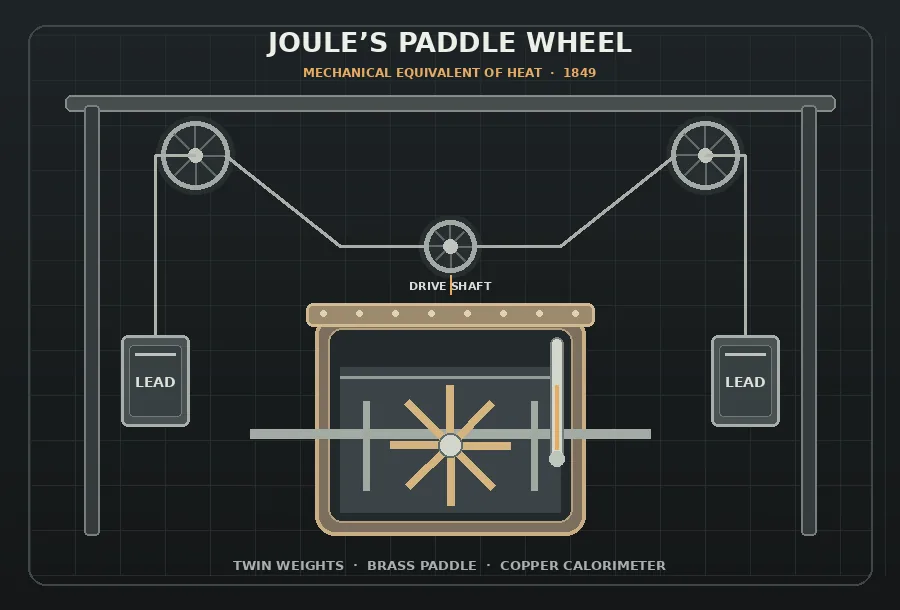
Two lead weights descend together. Their strings turn the axle; the paddle stirs the water against fixed vanes.
Collect a reading to estimate the mechanical equivalent from your own noisy measurements.
For two equal falling weights, the ideal gravitational work is W = 2mghN. Joule corrected the measured weight for pulley friction, corrected the fall for the small impact-speed loss, and added the energy stored in the stretched string. The reconstruction scales those published corrections with the selected mass, height and number of drops.
The calorimeter’s heat capacity is expressed as an equivalent mass of water, including the copper vessel, brass wheel and stopper. The measured rise gives the work needed to heat one pound of water by one Fahrenheit degree.
Joule’s Table I lists 40 individual water-friction gains. Their sample standard deviation is 0.03595 °F. The synthetic experiment treats this observed run-to-run scatter as an approximately Gaussian residual, scaled with the square root of the number of drops. A separate uniform quantisation term represents the selected thermometer increment; the two endpoint readings contribute a difference uncertainty of step/√6.
The radiation switch subtracts the historical mean raw-to-corrected drift of 0.012041 °F per 20-drop reading. The vacuum switch applies Joule’s published 773.640-to-772.692 correction. The Gaussian model is an educational approximation to the observed scatter, not a claim that all historical errors were normally distributed.
Primary source: J. P. Joule, “On the Mechanical Equivalent of Heat,” Philosophical Transactions of the Royal Society of London, 140 (1850), 61–82, especially Table I and Table IX.