MySimulator.ukSCIENCE LABS
ASTROPHYSICS LAB
GENERAL RELATIVITY

Event Horizon.

A real-time Schwarzschild black hole observatory

REFERENCE MASS
4.30 × 10⁶ M☉
Observation viewport
SCHWARZSCHILD METRIC INITIALIZING
Drag to orbit · Scroll to zoom · Click to probe
SIM TIME00:00:00
Ray telemetry
TRACKING PROBE
FREQUENCY SHIFT—ν observed / ν emitted
EMISSION RADIUS—Gravitational radii
IMPACT PARAMETER—Critical value 5.196 rɡ
PATH ANGLE—Along traced path
Frequency shift across the imageCLICK CHART TO MOVE PROBE
Image leftProbe scanlineImage right
Experiments

OBSERVER'S HANDBOOK

Field guide

What you see

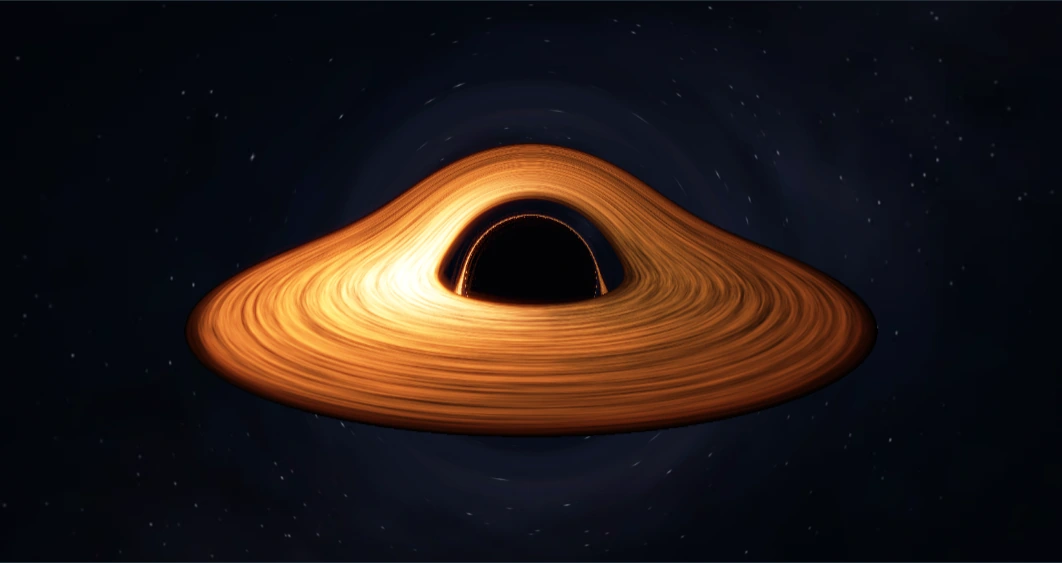
The dark region is the black hole shadow. It appears larger than the event horizon because light bends around the hole. The upper arc shows light from the far side of the disk. Narrower images closer to the shadow can contain light from the underside or rays that circled the hole.

How to observe

Drag to orbit, scroll or pinch to zoom, and click the image to pin a photon. Switch to Ray geometry to see its spatial path and select the landmark rings. The chart samples rays across the pinned image row. Gaps mark rays with no disk emission.

Read the units

One gravitational radius, rɡ = GM/c², is approximately 6.35 million km here. A frequency ratio below 1 is a redshift. Above 1 it is a blueshift. The printed simulation clock advances 60 coordinate seconds per real second at 1×.

Model assumptions

The hole is non-spinning and uncharged. The disk is thin, opaque and made of gas on circular orbits. Surface texture traces differential rotation. The image uses false colour and a reference emissivity; it does not predict the spectrum of a specific source.

Read the full technical article ↗
Made with 🤖 ChatGPT · Three.js