Presets
Playback
Haul or trench
Model checks
The science
What is modelled
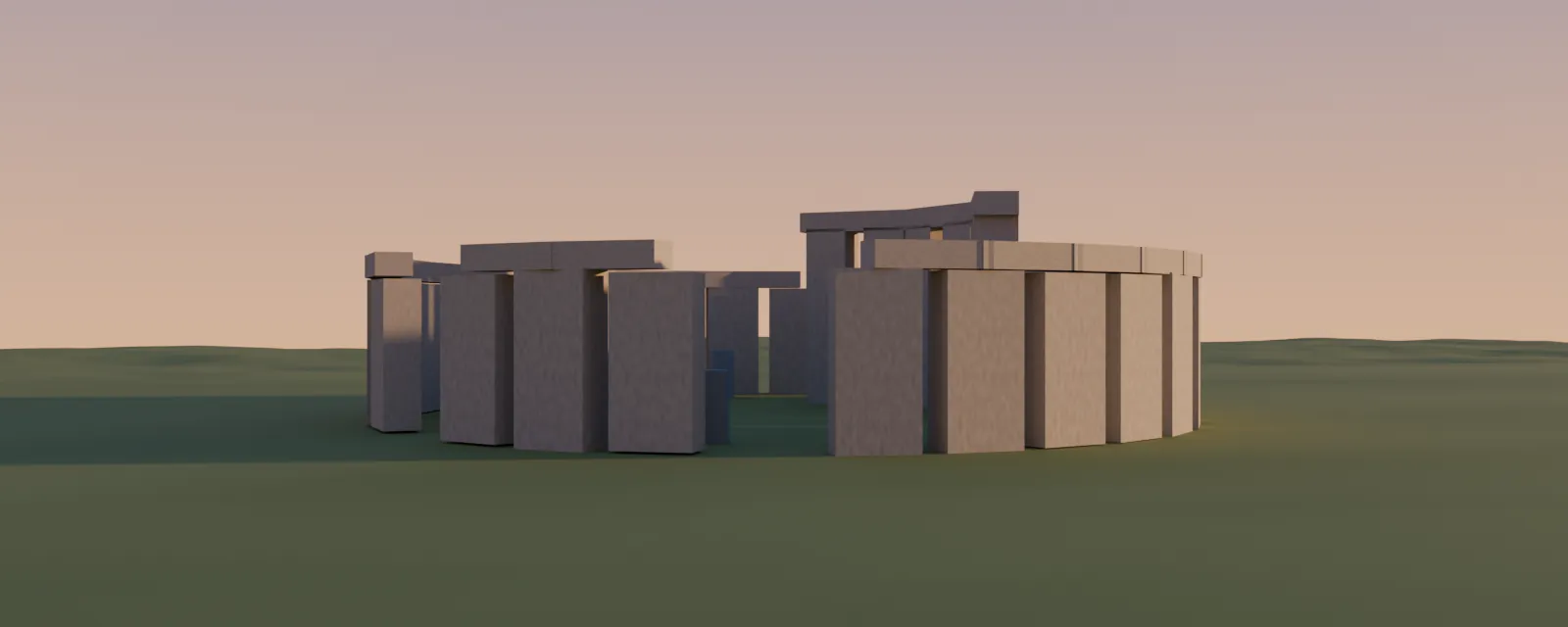
Two parts of the 3D Stonehenge lab in cross-section. First, hauling a stone on a sledge, rollers or a raft up a slope with a crew whose pull is a hypothesis range, plus a Monte-Carlo estimate of how many people that really needs. Second, a trench section with five layers and dated finds: radioactive decay gives raw ages, a model calibration curve turns them into calendar years, and the layer order (a Harris matrix) is used to flag a find that contradicts it. All coefficients are hypothesis ranges, not measurements; the calibration curve is invented for teaching and is not IntCal.
Equations
- Pull needed up a slope:
F = m g (c cos θ + sin θ); a sledge slides back whentan θ > μ, i.e. atθ = arctan μ. - Crew:
N = F / fwithf = 150 to 300 Nper person; steady speedv = vmax(1 − F/(N f)); workW = F d. - Monte-Carlo: draw
c,fand the daily walking rate uniformly from their ranges, 2000 times, and report the 5, 50 and 95 percentiles of the crew and of the days. - Radiocarbon:
N = N0 e−t/τwithτ = 5730 / ln 2 = 8267 y; aget = −τ ln(N/N0); errorσt = τ σN / N. - Stratigraphy: a later context must not give an older date than an earlier one it overlies.
Checks run in the page
- Slip angle by stepping the slope against arctan(mu); work by time-stepping a haul and integrating F dx.
- Monte-Carlo mean force against the centre of the ranges; the 25 t worked example (49.03 kN, 197 people).
- Radiocarbon age by bisection against the logarithm; half-life; the Harris matrix has no cycle and a planted cycle is caught; the contaminated find is flagged.
Honest simplifications
How the stones were really moved is debated; this page only shows what each hypothesis would demand. Friction is a single coefficient, the crew pulls in a steady tow, and the finds and their N/N0 values are model data for the exercise, not published results. Not affiliated with any heritage body.
What to try
- Press Sarsen on the level and read about 200 people; then Sarsen up a 3 degree rise and watch the crew needed grow.
- Press Slope steeper than mu: tan(slope) beats the coefficient, so the load slides back without stop-logs however large the crew.
- Press Antler pick dating, then step through the finds: the rootlet charcoal R5 is red because it is younger than the layer above it.
- Raise the counting precision slider and see the calibrated range of one find widen.