A fleet of eighty
Eighty independently simulated chaika boats are divided into four squadrons. Wind, stance, spacing, rowing endurance, hull integrity and squadron orders shape their movement.
THE BLACK SEA · 1616
Please enable WebGL2 and run this site through the development or production web server.
Read the historical account insteadTHE BLACK SEA FRONTIER
In 1616, the Zaporozhian Cossacks carried their war into the Black Sea. Their flotillas of shallow-draft boats challenged larger vessels, struck coastal settlements and targeted the ports of an Ottoman-dominated maritime world.
Petro Konashevych-Sahaidachny is associated with a successful Cossack expedition against Caffa (Kaffa), the major Crimean port now called Feodosia. Contemporary and later accounts connect the attack with the release of people held in slavery. The city had long been a major trading centre, including a trade in enslaved people. The raid was also a violent military attack whose details are incompletely documented.
Because no surviving battle plan or verified vessel-by-vessel roster establishes precisely how the expedition unfolded, this experience models plausible decisions rather than documented minute-by-minute events. The coastline, fortress proportions, troop placements, patrol routes, weather and results are interpretive.
EXAMINE HISTORICAL SOURCES ↗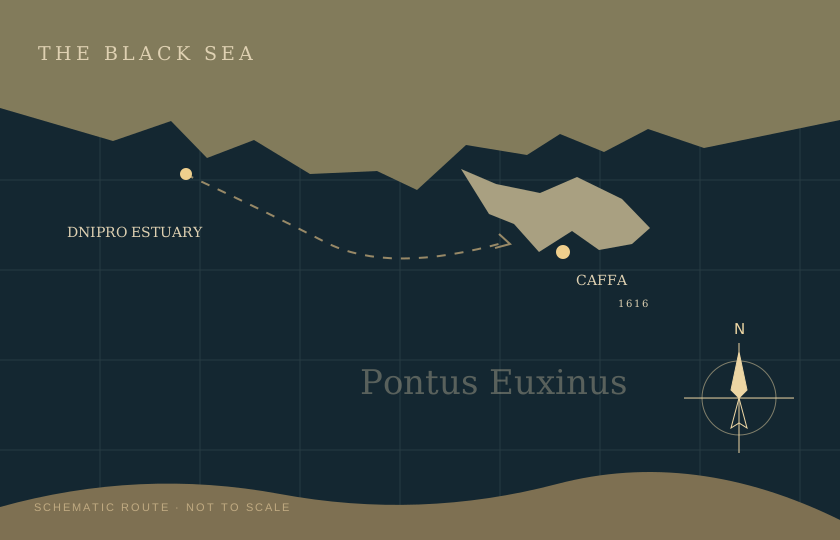
Expedition geography. The Cossacks came from the Dnipro basin; Caffa stood on the south-eastern coast of Crimea. Schematic, not to scale.
Selected documented episodes in Cossack maritime and political history; not the playable mission timeline.
A Cossack raid on the Anatolian coast, recorded in later historical syntheses.
Cossack naval activity reaches the approaches of Constantinople.
Sources associate Sahaidachny with a raid on the fortified Crimean port.
Sahaidachny dies in Kyiv; Sakovych's memorial verses help preserve his story.
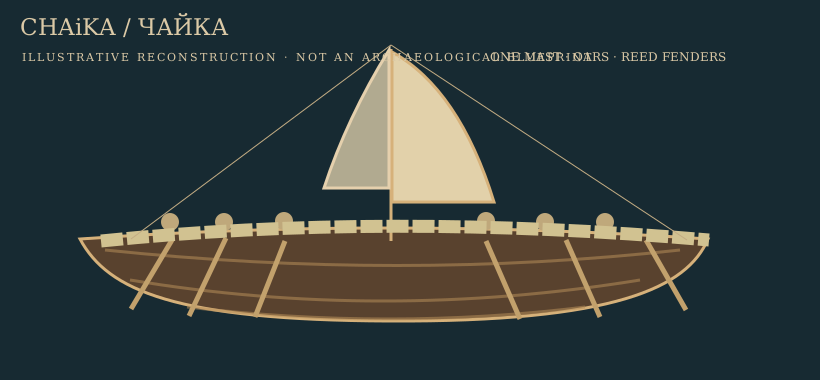
Chaika profile: plank-built sides over a dugout base, oars, a sail, reed fenders and steering at both ends. Approximate illustration after later descriptions, not a measured 1616 wreck.
THE SMALL BOAT ADVANTAGE
The chaika was a manoeuvrable Cossack warboat, typically described as roughly 18–20 metres long, propelled by oars and a single sail.
Guillaume Le Vasseur de Beauplan's mid-17th-century account describes reed bundles fastened along the sides, two steering positions and crews commonly estimated at 50–60 people. These descriptions postdate the 1616 raid, and scholars caution that dimensions varied and no excavated 1616 chaika securely settles every construction detail.
In the simulation, silent rowing keeps alert levels down but reduces speed, while a forceful advance improves momentum at the price of detection. A squadron can hold position, advance or surge; the modeled patrols respond to visibility, noise and distance.
Eighty independently simulated chaika boats are divided into four squadrons. Wind, stance, spacing, rowing endurance, hull integrity and squadron orders shape their movement.
Patrol vessels react to approaching targets; defenses become more dangerous as alarm grows. Changing weather and illumination alter visibility and the risk of discovery.
Shore parties advance through defensive sectors. A simplified evacuation model tracks rescued captives, embarkation capacity, casualties and pressure from the garrison.
Procedural terrain, streets, Genoese-era-derived walls, Ottoman-period port life, birds, woodland, wave lighting, smoke, patrols and garrison movement make the scene evolve.
01. Drag the world to orbit and scroll or pinch to zoom. Tap a boat, patrol ship or tower to inspect it.
02. Select an approach stance, fleet formation and squadron. Order individual squadrons to hold, advance or surge.
03. Order the landing, manage alert and evacuation, then withdraw. Use the tactical map, camera presets, speed and weather controls.
04. Choose Free Camera to fly with WASD, Q/E and Shift on desktop; orbit mode works with touch on mobile.
A NOTE ON WHAT WE KNOW
Historians identify a Cossack raid on Caffa in 1616 and connect it with Sahaidachny. They do not possess a complete, georeferenced tactical account. Published estimates of ships, crews, the exact sequence and losses differ. This project deliberately separates the documented core from the invented tactical sandbox.
Early-seventeenth-century Cossack Black Sea raiding; a 1616 attack on Caffa; Sahaidachny's association with the campaign; the use of oar-and-sail warboats; and the slave trade at Caffa.
The reconstructed coast and city, eighty-boat starting deployment, named squadrons, fleet orders, wind, patrol behavior, number of rescued people, event chronology and combat outcomes.
References are linked for independent reading. No source verifies the game's fictional tactical numbers or exact 3D map.
The Zaporozhian Cossacks attacked Caffa, an Ottoman-held port in Crimea, during a Black Sea campaign associated with Petro Konashevych-Sahaidachny. Historical narratives describe a successful raid and the freeing of enslaved people. Exact operational details and numerical claims vary among accounts.
He was a prominent early-17th-century Ukrainian Cossack military and civic leader, closely associated with the Zaporozhian Host and its sea campaigns. He died in Kyiv in 1622. His role also extended to Orthodox cultural and religious life.
A chaika was a narrow, shallow-draft vessel used by Zaporozhian Cossacks. Sources describe multiple pairs of oars, a mast and sail, planked sides over a hollowed timber, and reed bundles as fenders or buoyancy aids. Sizes and armament varied, and precise reconstruction remains debated.
It is historically informed, not a documentary reconstruction. The 1616 campaign is attested, but the playable geography, fleet array, defensive patrols, tactical controls, timings, rescue quota and casualty models are intentionally invented educational mechanisms.
Orbit the camera with a drag, zoom, choose a fleet formation and approach stance, then command the landing. Use the four squadron tabs for local orders, inspect ships by clicking them, and attempt an evacuation before ordering withdrawal. Desktop users can switch to Free Camera with WASD and Q/E controls; mobile users can pinch and drag.