Parrot Echo: the map view (2D)
The science
Speed of sound. In dry air c = 331 + 0.6 T m/s (T in degrees C), the textbook linear fit of c = sqrt(gamma R T_K): 343 m/s at 20 C. It does not depend on pitch or loudness (the pitch slider changes only the sound you hear and the wavelength lambda = c/f).
Echo delay. Sound travels to the cliff and back: t = 2 d / c. A cliff 100 m away at 20 C gives 0.583 s. The echo is heard as a separate sound if it arrives after the call has ended plus roughly 0.05 s (a typical value for the ear); otherwise it blends in or overlaps the call.
Two cliffs (canyon). Between parallel cliffs at +d1 and -d2 every echo comes from an image source at x = 2 d1, -2 d2, then further images, and arrives after (distance of the image) / c. Each wall bounce multiplies the pressure by R. The circles on the map are exactly these image sources.
Wave map. The coloured field is the numerical solution of the linear acoustic equations dq/dt = -c div u, du/dt = -c grad q (q = p/rho c) in 2-D, on a staggered grid with Courant number 0.6. A cliff of reflection coefficient R is an impedance boundary u = q (1-R)/(1+R); the top, bottom and open back edge are absorbing sponge layers. A wave spreading in a plane loses strength as 1/sqrt(r), so the echo looks weaker than the call. The call is a sin2-enveloped 4-cycle wave of length Tc, a slowed and stretched picture of a kHz call.
Checks that do not reuse the renderer. A separate 1-D grid with a short call measures the echo time against 2d/c, the echo strength against R, the arrival time at a different pitch (must not change) and the second canyon echo against the image-source value; a 2-D grid run measures the speed of the front between two receivers; and the fit 331 + 0.6 T is compared with sqrt(gamma R T). The same numbers appear on the 3D page because both use the same core file.
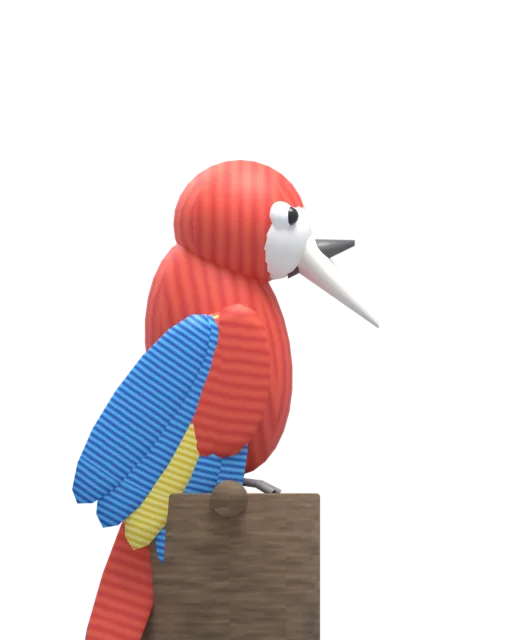
Simplifications. Flat vertical cliffs, no wind, no temperature layers, no ground echo, no loss of sound in the air (this would remove high pitches over long distances). The picture is a horizontal slice at the height of Polly; the map is not to scale for Polly herself. Audio is synthesised and echo loudness in the audio is a listening curve. Parrot, cliff and the ground are rendered from Blender models.