The science of the penalty kick
The ball is integrated in 3D with a time step of 1 ms: m dv/dt = -m g - ½ ρ Cd A |v| v + ½ ρ A CL |v|² (ω×v)/|ω||v|, with the real ball (m = 0.43 kg, r = 0.11 m), air density 1.2 kg/m³, drag coefficient 0.25 and the penalty spot 11 m from a goal that is 7.32 m wide and 2.44 m high. The charge bar sets the kick speed (power shot: 20 to 33 m/s, about 70 to 119 km/h; finesse shot: 18 to 24 m/s with side spin of 8 rev/s, which curves the ball by the Magnus force; the lift coefficient is taken proportional to the spin ratio rω/v and capped at 0.35). The launch angles are solved so that the ball would reach the aimed zone centre.
Accuracy and keeper
Speed costs accuracy: the landing point scatters with a Gaussian of 0.18 m + 0.9 m × (power/100)² (a modelling choice that reproduces the known speed-accuracy trade-off, not a measured value). A harder shot can miss or hit the woodwork. The keeper first guesses a zone (difficulty sets how well he reads you); if the guess matches the zone where the ball lands, he must also get there in time: reaction time plus a dive with constant acceleration 24 m/s² from the centre of the goal, t = treact + √(2 s / a), where s is the distance to the ball's arrival point (reaction offsets: -0.05 s normal; a negative value means he leaves before the strike). Flight time is the ball's real time to the goal line, so a fast shot to a corner beats even a correct guess, while a central shot or a slow finesse shot can be saved.
Simplifications
- Point-mass ball with a constant drag coefficient (no drag crisis, no knuckle effect), spin does not decay, no wind.
- The goal is drawn stretched vertically for gameplay (the real frame is 3:1); the physics uses the real dimensions. The 3x2 zone grid and the keeper's dive acceleration are game abstractions.
- This is an educational game model, not a prediction for real players.
Checks (run on load)
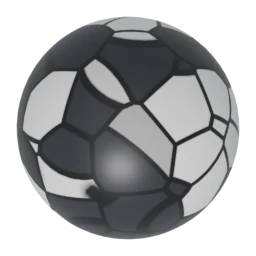
Ball, goalkeeper and goal artwork rendered with Blender (Cycles); the physics runs live in the page.