Beneath the Riverbed
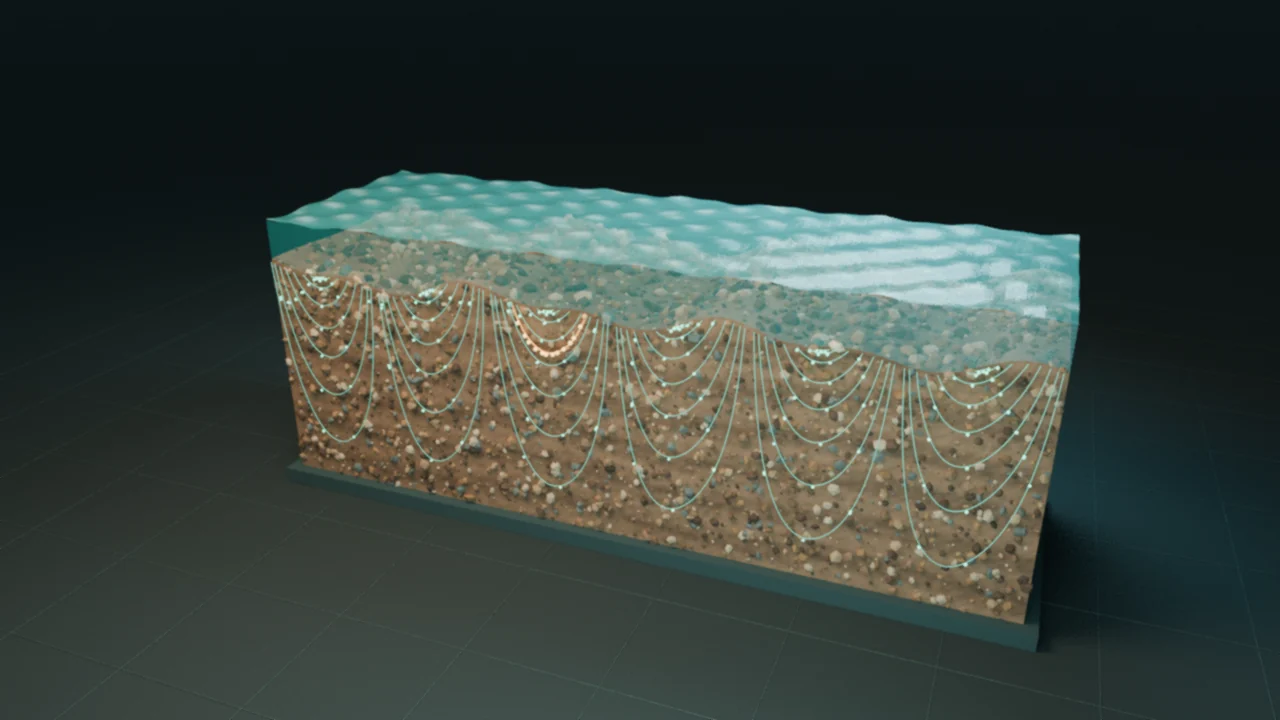
Riverbed ripples create pressure differences that drive water into the gravel and back into the river. Follow the exchange in a live 3D cutaway.
The Science Equations, validation and model limits
Pressure drives pore flow
For depth d below the bed, hydraulic head is h(x,d) = H cos(kx) exp(−kd), where k = 2π/λ. The model imposes the head amplitude H at the interface. Darcy flux is q = −K∇h, and pore velocity is v = q/n for hydraulic conductivity K and effective porosity n.
Particles follow dx/dt = V exp(−kd) sin(kx) and dd/dt = V exp(−kd) cos(kx), with V = KHk/n. A fixed 0.25 s RK4 step integrates their motion. Streamlines conserve exp(−kd) sin(kx). The release offset is measured from the high-pressure point. Its mirrored exit lies at λ/2 minus that offset. “Infiltration flux” is the positive downward flux averaged over one wavelength, KHk/π.
Vertical travel-time check
At the head maximum, horizontal speed is zero. Separating the vertical equation gives the time to travel one decay length, t = (e−1)/(kV). The engine independently integrates this trajectory and locates the depth crossing within the final RK4 step. The audit step is 1/(100kV) so the comparison has the same dimensionless resolution at every setting. This checks the integrator, not predictions at a field site.
- RK4 engine · ILLUSTRATIVE
- —
- Analytical reference · TEXTBOOK
- —
- Relative difference
- —
What the cutaway represents
The bed is homogeneous, isotropic, fully saturated, laterally periodic and effectively deep. The pressure pattern stays fixed. The model omits sediment motion, groundwater gradients, molecular diffusion, dispersion and turbulent exchange. It solves the pore-water flow beneath an ideal flat interface. The river current, grains and ripple relief are illustrative. SCALED geometry shows three wavelengths and exaggerates depth by 2×. The displayed slice ends at 0.46λ, so exceptionally deep paths can be clipped.