Governing equations
Two coupled reaction–diffusion partial differential equations
∂U/∂t = Dᵤ ∇²U − U V² + F(1 − U)
∂V/∂t = Dᵥ ∇²V + U V² − (F + k)V
∂V/∂t = Dᵥ ∇²V + U V² − (F + k)V
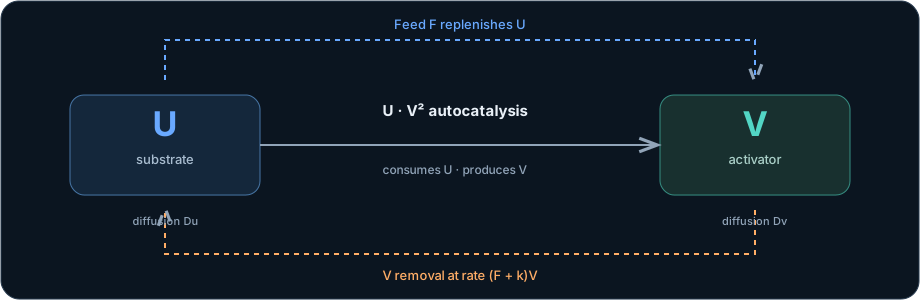
U · Substrate
Diffuses, is consumed by the autocatalytic reaction and is replenished by feed F.
Diffuses, is consumed by the autocatalytic reaction and is replenished by feed F.
V · Activator
Diffuses, is produced by U·V² autocatalysis and is removed by feed-plus-kill loss.
Diffuses, is produced by U·V² autocatalysis and is removed by feed-plus-kill loss.
Probe location
Choose a cell to inspect its local state
Local state & rates
Instantaneous derivative at the selected cell
U0.000
V0.000
dU / dt0.000
dV / dt0.000
∇²U = 0.0000
∇²V = 0.0000
U·V² = 0.0000
∇²V = 0.0000
U·V² = 0.0000
Term-by-term contribution
Signed contributions to each species derivative at the probe
Substrate equation · dU/dt
Activator equation · dV/dt
The Laplacian uses a nine-point stencil with zero-flux (clamped-neighbour) boundaries. Rates are evaluated from the current discrete field.