EXPERIMENTAL REFERENCE / ANATOMY
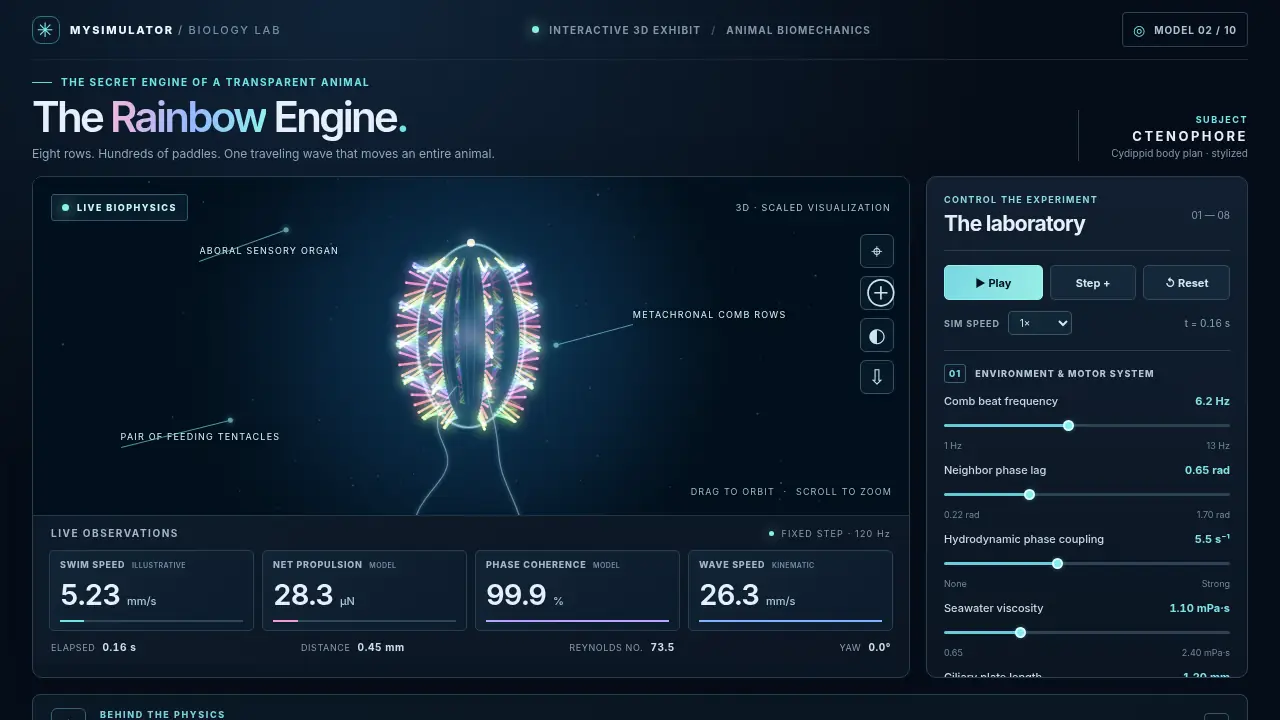
They row using combs of fused cilia.
A ctenophore has eight external meridional bands of comb plates (ctenes). The plates beat in a coordinated, traveling metachronal pattern. A sensory organ near the aboral pole influences orientation and swimming. Rainbow bands primarily arise from structural diffraction of ambient light by cilia — not from bioluminescence.
This scene shows a generic cydippid body, simplified internal canals, aboral organ and paired tentacles. Fine details, fin thickness and rainbow intensity are visibly exaggerated.
ILLUSTRATIVE / COUPLED OSCILLATORS
Phase waves, not marching lights.
Each comb plate is an independently integrated phase oscillator with nearest-neighbor coupling. With phase lag Δ, adjacent paddles achieve a traveling wave:
dθᵢ/dt = ωᵢ + K[sin(θᵢ₋₁ − θᵢ − Δ) + sin(θᵢ₊₁ − θᵢ + Δ)]
For constant frequency and a locked wave, c = 2π f d / Δ, where d is comb-plate spacing. This kinematic wave speed is not the swimming speed.
TEXTBOOK FORM / ILLUSTRATIVE COEFFICIENTS
From paddle force to body motion.
Individual paddles use a scaled anisotropic drag closure. Their projected power-stroke area exceeds recovery-stroke area. The summed net force accelerates the body against seawater resistance:
m dU/dt = Σ Fᵢ − 6πμRU − ½ρCᴅA U|U|
Stokes and quadratic drag formulas are textbook forms. Paddle efficiency, geometry, coordination multiplier, effective inertia and torque are illustrative. This model does not solve fluid–structure Navier–Stokes equations, reconstruct dynein motors, or predict the velocity of a named species.
Illustrative educational model, not affiliated with any real institution or manufacturer.